Venus

[ad_1]

                         “Venus: The Hottest Planet in Our Solar System”

Venus is the second planet from the Sun and is often referred to as Earth’s “sister planet” due to their similar size and composition. Here are some key points about Venus:

Size and Composition: Venus has a diameter of about 12,104 kilometers (7,521 miles), making it slightly smaller than Earth. It has a rocky surface and is primarily composed of silicate rock and metal. Its atmosphere is mostly carbon dioxide (about 96%) with traces of nitrogen and other gases.

Atmosphere: Venus has a thick and dense atmosphere that creates a runaway greenhouse effect, making it the hottest planet in our solar system. The atmospheric pressure on Venus is about 92 times greater than Earth’s, equivalent to being submerged 900 meters (3,000 feet) underwater.

Surface Conditions: The surface of Venus is inhospitable with extreme temperatures averaging around 462 degrees Celsius (864 degrees Fahrenheit), which is hotter than the surface of Mercury despite Venus being further from the Sun. The atmospheric pressure and heat create a hostile environment where the air is thick and clouds of sulfuric acid dominate the skies.

Rotation and Orbit: Venus rotates on its axis very slowly, taking about 243 Earth days to complete one rotation. It orbits the Sun every 225 Earth days, following a nearly circular path. Interestingly, Venus has a retrograde rotation, meaning it spins in the opposite direction to most other planets.

Exploration: Venus has been studied extensively by space probes and telescopes. The first spacecraft to successfully land on Venus was the Soviet Union’s Venera 7 in 1970. Since then, several other missions, including the Venera and Pioneer programs, as well as NASA’s Magellan and ESA’s Venus Express, have provided valuable information about Venus’s atmosphere and surface.

Possibility of Life: Venus is considered a hostile environment for life as we know it due to its extreme temperatures, high atmospheric pressure, and acidic clouds. However, some scientists speculate that microbial life could potentially exist in the upper cloud layers where temperatures and pressures are more moderate.

Transit of Venus: One notable astronomical event associated with Venus is the transit of Venus. It occurs when Venus passes directly between the Earth and the Sun, appearing as a small, black dot crossing the face of the Sun. Transits of Venus are rare and occur in pairs separated by eight years, with more than a century between each pair.

Please note that scientific understanding and discoveries about Venus are continuously evolving as new research and missions take place.

#Venus
#PlanetVenus
#VenusFacts
#VenusExploration
#VenusianAtmosphere
#VenusSurface
#VenusMission
#VenusianClouds
#VenusTransit
#VenusLove
#VenusianBeauty
#VenusianSkies
#VenusObserved
#VenusScience
#VenusianLife

Facebook: https://www.facebook.com/profile.phpid=100087106114908
Twitter : https://twitter.com/bestpaperaward
Pinterest : https://in.pinterest.com/bestpaperaward
Linkedin : https://www.linkedin.com/in/esha-gupta-18b2b4245
Instagram: https://www.instagram.com/eshagupta__2022/


[ad_2]

Source link

Neptune

[ad_1]

                                    “Neptune: The Mysterious Blue Planet”

Neptune is the eighth and farthest known planet from the Sun in our solar system. It is the fourth-largest planet by diameter and the third-largest by mass. Neptune is named after the Roman god of the sea due to its striking blue color, reminiscent of the ocean.

Here are some key facts about Neptune:

Distance from the Sun: Neptune is located about 4.5 billion kilometers (2.8 billion miles) away from the Sun on average. Its orbit is highly elliptical, and it takes approximately 165 Earth years to complete one orbit around the Sun.

Size and Composition: Neptune has a diameter of about 49,500 kilometers (30,800 miles), making it nearly four times larger than Earth. It has a dense atmosphere composed mostly of hydrogen and helium, along with traces of methane, which gives the planet its blue color.

Moons: Neptune has 14 known moons, the largest of which is Triton. Triton is unique among the moons in our solar system because it has a retrograde orbit, meaning it orbits Neptune in the opposite direction of the planet’s rotation. Other notable moons include Nereid, Proteus, and Larissa.
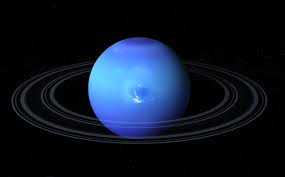
              

Rings: Like other gas giant planets, Neptune has a system of rings. These rings are composed of ice particles and are much fainter and less prominent than the rings of Saturn. The rings are named after astronomers who made significant discoveries related to Neptune, such as Galle, Le Verrier, and Lassell.

Exploration: The only spacecraft to visit Neptune is NASA’s Voyager 2, which flew by the planet in 1989. Voyager 2 provided valuable data and images of Neptune and its moons, revealing details about the planet’s atmosphere and geology.

Characteristics: Neptune has a dynamic atmosphere with high-speed winds and large storm systems. The most famous storm on Neptune is the Great Dark Spot, which was observed by the Hubble Space Telescope in 1989 but has since disappeared. Another notable feature is the “scooter,” a dark spot observed in the atmosphere that moves at high speeds.

It’s worth noting that my knowledge cutoff is in September 2021, so there may have been new discoveries or information about Neptune since then.

#Neptune
#BluePlanet
#OuterPlanet
#SolarSystem
#SpaceExploration
#GiantPlanet
#NeptunianMoons
#Astronomy
#PlanetaryScience
#Voyager2
#NeptuneFacts
#NeptuneDiscovery
#SpaceMission
#NeptuneAtmosphere
#NeptuneRings

Facebook: https://www.facebook.com/profile.phpid=100087106114908
Twitter : https://twitter.com/bestpaperaward
Pinterest : https://in.pinterest.com/bestpaperaward
Linkedin : https://www.linkedin.com/in/esha-gupta-18b2b4245
Instagram: https://www.instagram.com/eshagupta__2022/


[ad_2]

Source link

Pluto

[ad_1]

                                      “New Horizons: Journey to Pluto”

Pluto is a dwarf planet located in our solar system. It was once considered the ninth planet, but in 2006, the International Astronomical Union (IAU) redefined the definition of a planet, and Pluto no longer met the criteria.

Here are some key facts about Pluto:

Size and Distance: Pluto is the largest known dwarf planet in our solar system. It has a diameter of about 2,376 kilometers (1,476 miles), which is roughly two-thirds the size of Earth’s moon. Its average distance from the Sun is approximately 5.9 billion kilometers (3.67 billion miles).

Orbit and Rotation: Pluto has an eccentric and tilted orbit compared to the major planets. It takes about 248 Earth years to complete one orbit around the Sun. Pluto also has a slow rotation, completing a full rotation on its axis in about 6.4 Earth days.

Composition: Pluto is primarily composed of rock and ice, similar to other dwarf planets in the Kuiper Belt. Its surface is covered in a layer of frozen nitrogen, methane, and carbon monoxide. It also has mountains, plains, and valleys.

Moons: Pluto has five known moons: Charon, Styx, Nix, Kerberos, and Hydra. The largest moon, Charon, is so massive that the Pluto-Charon system is often referred to as a binary system.

New Horizons Mission: In July 2015, NASA’s New Horizons spacecraft conducted a flyby of Pluto, providing us with the most detailed images and data we have of the dwarf planet to date. The mission revealed a complex and geologically active world with a diverse landscape.

Despite no longer being classified as a planet, Pluto remains an intriguing object of study for astronomers and planetary scientists. Its exploration has provided valuable insights into the outer regions of our solar system and the dynamics of dwarf planets.

#Pluto
#DwarfPlanet
#PlutoFlyby
#NewHorizons
#PlutoExploration
#PlutoFacts
#PlutoMission
#PlutoResearch
#PlutoScience
#PlutoSystem

Facebook: https://www.facebook.com/profile.phpid=100087106114908
Twitter : https://twitter.com/bestpaperaward
Pinterest : https://in.pinterest.com/bestpaperaward
Linkedin : https://www.linkedin.com/in/esha-gupta-18b2b4245
Instagram: https://www.instagram.com/eshagupta__2022/


[ad_2]

Source link

Asteroids

[ad_1]

                                    “Asteroids: Stepping Stones to the Stars”

An asteroid is a small celestial body that orbits the Sun. It is composed primarily of rock and metal and is much smaller than a planet. Most asteroids are found in the asteroid belt, a region between the orbits of Mars and Jupiter, although they can also exist in other locations in the solar system.

Asteroids come in various sizes, ranging from small boulders to objects several hundred kilometers in diameter. They are remnants from the early stages of our solar system’s formation, and studying them can provide insights into the processes that shaped the planets and other celestial bodies.

Asteroids can be classified into different types based on their composition. Some are rocky and metallic, while others contain a significant amount of carbonaceous material. Additionally, some asteroids are classified as “rubble piles” due to their loose and fragmented structures.

Occasionally, asteroids can pose a threat to Earth if their orbits intersect with our planet’s path. If a large asteroid were to collide with Earth, it could have catastrophic effects, potentially causing significant damage and global environmental consequences. However, the probability of such an impact occurring in the near future is low, and scientists are actively monitoring asteroids to identify any potential risks and develop strategies for planetary defense.

Space agencies, such as NASA, have conducted missions to study asteroids up close. These missions involve sending spacecraft to rendezvous with asteroids, collect samples, and gather data about their composition, structure, and behavior. Notable missions include NASA’s OSIRIS-REx mission to the asteroid Bennu and Japan’s Hayabusa2 mission to the asteroid Ryugu.

Studying asteroids is crucial not only for understanding the history and formation of our solar system but also for preparing and protecting our planet from potential asteroid impacts in the future.

#Asteroid
#SpaceRock
#AsteroidBelt
#AsteroidMission
#NASA
#SpaceExploration
#Astronomy
#AsteroidResearch
#PlanetaryDefense
#SpaceScience
#AsteroidImpact
#AsteroidMining
#AsteroidSampleReturn
#NEO (Near-Earth Object)
#SpaceDiscovery
#AsteroidWatch
#SpaceMission
#AsteroidScience
#AsteroidAwareness
#AsteroidDeflection

Facebook: https://www.facebook.com/profile.phpid=100087106114908
Twitter : https://twitter.com/bestpaperaward
Pinterest : https://in.pinterest.com/bestpaperaward
Linkedin : https://www.linkedin.com/in/esha-gupta-18b2b4245
Instagram: https://www.instagram.com/eshagupta__2022/


[ad_2]

Source link

Antartic Region

[ad_1]

                                       “Antarctica: The Frozen Continent”

The Antarctic region refers to the area surrounding the Earth’s South Pole and is located in the southernmost part of the globe. It is one of the Earth’s polar regions, along with the Arctic region in the North. Here are some key points about the Antarctic region:

Geography: Antarctica is a vast continent covered by ice, with an area of about 14 million square kilometers (5.5 million square miles). It is surrounded by the Southern Ocean.

Climate: Antarctica is the coldest place on Earth, with extremely low temperatures. During the winter, temperatures can plummet to as low as -60°C (-76°F) or even lower in certain areas. The continent 

experiences long periods of darkness during the winter and long daylight hours during the summer.

Research and Science: Despite its harsh conditions, Antarctica is a crucial location for scientific research. Many countries operate research stations on the continent to study various aspects of climate, geology, biology, and astronomy. It also serves as an essential monitoring site for global climate changes.

Environmental Protection: The Antarctic Treaty System, signed in 1959, designates Antarctica as a scientific preserve and prohibits military activity, mineral mining, and nuclear testing. The treaty’s main goal is to promote scientific cooperation and protect the unique and fragile ecosystem of the region.

Wildlife: Antarctica is home to various species of wildlife, including penguins, seals, whales, and seabirds. These animals have adapted to the extreme conditions and rely on the nutrient-rich Southern Ocean for their survival.

Tourism: Although the Antarctic region is not densely populated, there is a growing interest in Antarctic tourism. Visitors have the opportunity to witness its stunning landscapes, wildlife, and ice formations, but it’s essential to ensure that tourism activities are conducted in an environmentally responsible manner to protect the fragile ecosystem.

Remember that the Antarctic region is a unique and sensitive environment, so any exploration or tourism must be done with the utmost care and respect for its delicate ecosystem.

#Antarctica
#Antarctic
#SouthPole
#PolarRegion
#Iceberg
#FrozenContinent
#Penguins
#Seals
#Whales
#WildlifeAntarctica
#ScientificResearch
#ClimateStudy
#EnvironmentalProtection
#AntarcticExploration
#AntarcticAdventure

Facebook: https://www.facebook.com/profile.phpid=100087106114908
Twitter : https://twitter.com/bestpaperaward
Pinterest : https://in.pinterest.com/bestpaperaward
Linkedin : https://www.linkedin.com/in/esha-gupta-18b2b4245
Instagram: https://www.instagram.com/eshagupta__2022/


[ad_2]

Source link